

The Towrds Org Chart
A GovCon Org Chart Framework to get the Right Who’s in the Right Seats
BLUF
Your org chart reflects your hiring history, not your strategy. Those are very different documents.
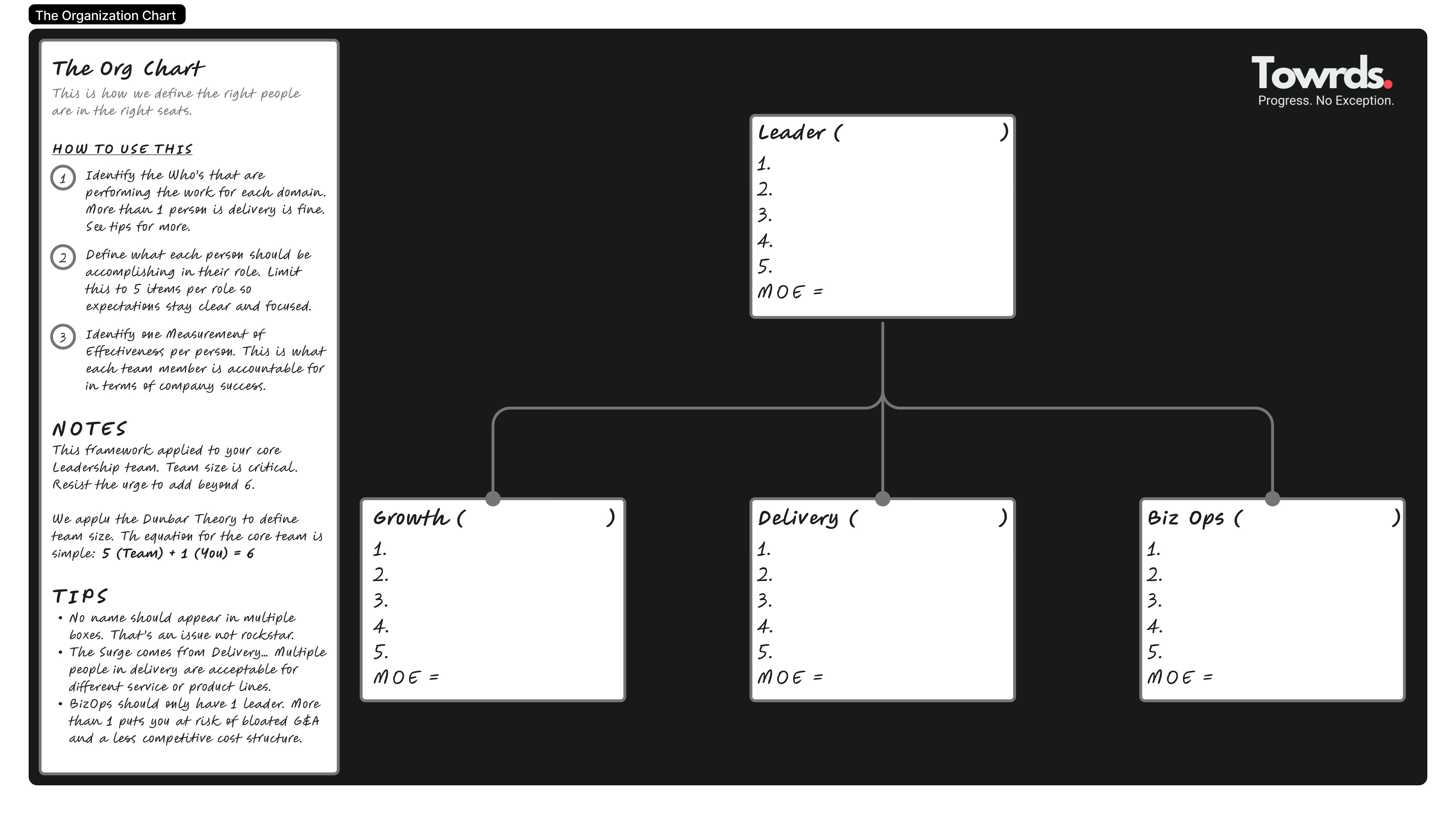
The GovCon Value Chain already drew your org chart. Growth, Delivery, Supporting Activities. Three lanes. Full stop.
Every role needs a definition and one Measurement of Effectiveness. One. Not five. One.
Six people is the ceiling on your core team. Beyond that, you’re not leading… you’re moderating.
The right person in the wrong seat isn’t a people problem. It’s a clarity problem you created.
What This Is
Most GovCon founders don’t have an org chart problem. They have a clarity problem. The chart itself is just the symptom of the real issue that nobody defined the seats before people started sitting in them.
This framework fixes that.
The Org Chart is a one-page tool built specifically for GovCon firms in the $25M to $250M range. It gives you a structured way to define who owns each domain in your business, what they’re responsible for, and how you’ll measure whether they’re actually succeeding.
It’s built on a simple principle: your org structure should reflect your business model… not your hiring history.
The GovCon Value Chain Has Three Lanes
Every GovCon business, regardless of size, contract vehicle, or service line, operates across three GovCon Value Chain fundamental areas: Growth, Delivery, and Supporting Activities.
That’s it.
If your org chart has more complexity than that at the top, you’ve likely been promoting to the problem rather than solving it.
Your core leadership team should map directly to those three areas:
Growth leader: who owns client attraction, pipeline, capture, and proposals
Delivery leader (or one per business unit): who owns performance and execution
Business Operations leader: who keeps the engine running without bloating your G&A.
That’s four seats.
Six Is the Ceiling
We apply Dunbar’s Theory to leadership team design. Your core team should never exceed six people: five leaders and you. Once you cross that line, you’re not running a leadership team anymore, you’re running a meeting circuit. And meetings don’t win contracts.
How to Use the Framework
The one-page guide below walks you through three steps. First, identify who is doing the work in each domain. Second, define what success looks like in that role, no more than five things, or the role isn’t real yet. Third, assign one Measurement of Effectiveness per person. One. The number of things someone is ultimately accountable for should not require a spreadsheet.
Why This Is the Step Most Leaders Skip
Defining roles is uncomfortable because it requires telling people what their job actually is. Not what they think it is. Not what they negotiated for. What the business needs from that seat.
That conversation is hard. But the alternative, letting people drift into adjacent domains, doing jobs nobody assigned them, building fiefdoms out of ambiguity, is what turns a $50M firm into a waterfalling firm five years in a row.
Download the framework below. Twenty minutes of honest work here is worth more than most strategy offsites.